
Korean Rhapsody: Sijo | Traditional Korean Poetry Takes Shape in Brush, Body, and Space

Gallery B612 presents a Korean Cultural Week program during Seattle Art Fair Week, with support from the Consulate General of the Republic of Korea in Seattle and Margolis Arts Foundation.

As part of Korean Cultural Week, Gallery B612 presents Korean Rhapsody: Sijo | 시조, a Korean cultural program introduced during Seattle Art Fair week, with support from the Consulate General of the Republic of Korea in Seattle and Margolis Arts Foundation. Gallery B612 will present the program at Seattle Art Fair 2026 in Booth D17.
Conceived and artistically directed by MiYoung Seul Margolis 설미영, the program brings together exhibition, Korean poetry, contemporary visual art, live interdisciplinary performance, and hands-on cultural learning as one connected cultural experience.
Presented by Gallery B612, Korean Rhapsody: Sijo (시조) brings together traditional Korean poetry, Korean painting, contemporary visual art, live interdisciplinary performance, and the symbolic world of Sagunja (사군자), the Four Gentlemen of Korean brush painting. The program invites audiences to experience Korean culture not only as history, but as a living and contemporary artistic language.
At its heart, Korean Rhapsody: Sijo explores how the wordplay and emotional subtlety of a Korean poem can move beyond language and take shape as visual art, movement, and atmosphere. What begins as poetic wit becomes a brushstroke; what begins as longing becomes a gesture; and what begins as a few carefully chosen words becomes a quiet fragrance that fills the space.

About Sijo:
A Korean Poetic Form of Rhythm, Restraint, and Wit
Sijo (시조, pronounced SEE-jo) is a uniquely Korean poetic form that developed from the late Goryeo period and flourished during the Joseon dynasty. Traditionally composed in three lyrical lines, Sijo is known for its musical rhythm, refined emotional restraint, and a subtle turn of thought that often reveals longing, humor, wisdom, reflection, or quiet surprise.
Unlike a long narrative poem, Sijo holds its power in compression. A few carefully chosen words can open an entire emotional landscape. The first line often introduces an image or situation, the second line expands the feeling or thought, and the final line brings a shift, reversal, or deeper realization. This structure allows Sijo to hold both discipline and play. It can be philosophical, romantic, humorous, political, devotional, or deeply personal, while remaining beautifully concise.
In this way, Sijo shares a deep connection with Korean painting. Both value space, suggestion, rhythm, and what remains unsaid. A Sijo does not explain everything. A Korean brush painting does not fill every surface. Both forms invite the audience to enter the work through silence, imagination, and emotional intuition.
For this program, Gallery B612 draws inspiration from two important works in the Korean Sijo tradition: Hwang Jini’s “Cheongsan-ri Byeokgyesu-ya” and 'Yun Seondo’s Ouga, especially the imagery of the moon and bamboo.

Featured Sijo
At the center of Korean Rhapsody: Sijo are two poetic works that guide the emotional and visual language of the program: Hwang Jini’s “Cheongsan-ri Byeokgyesu-ya” and Yun Seondo’s “The Moon” from Ouga. One carries the wit and longing of a poetic invitation; the other offers the quiet companionship of moonlight. Together, they open the program’s connection between language, painting, movement, and space.
청산리 벽계수야 수이 감을 자랑 마라
일도창해하면 다시 오기 어려우니
명월이 만공산하니 쉬어 간들 어떠리
Blue stream in the green mountain, do not boast of flowing swiftly.
Once you reach the wide sea, it is hard to return.
The bright moon fills the empty mountain — why not rest here awhile?
황진이, 〈청산리 벽계수야〉
Hwang Jini, “Blue Stream in the Green Mountain” (Cheongsan-ri Byeokgyesu-ya)
Hwang Jini: Wordplay, Longing, and the Bright Moon
Hwang Jini, also known by her artistic name Myeongwol, meaning “Bright Moon,” is one of the most celebrated poetic voices of the Joseon dynasty. Remembered for her intelligence, artistry, beauty, and independence, Hwang Jini occupies a singular place in Korean cultural memory. Her poems are admired not only for their lyricism, but also for their wit, layered meaning, and emotional sophistication.
Her Sijo “Cheongsan-ri Byeokgyesu-ya” is especially powerful because of its language play. On the surface, the poem speaks to a blue stream flowing through a green mountain, asking it not to rush away. But beneath the surface, the words carry another meaning. “Byeokgyesu” can be read as both a blue stream and the name of a man, while “Myeongwol,” Hwang Jini’s own artistic name, means bright moon. The poem becomes a delicate invitation: do not pass by too quickly; pause beneath the moonlight.

This layered wordplay is central to Korean Rhapsody: Sijo. The poem’s beauty is not only in what it says, but in how it transforms meaning. Nature becomes a person. A stream becomes desire. The moon becomes the poet herself. The landscape becomes a stage for longing, wit, and emotional intelligence.
In the program, this poetic wordplay expands beyond language. It becomes visual art. It becomes movement. It becomes an atmosphere that fills the space. The blue stream, the green mountain, and the bright moon are not illustrated literally; instead, they are translated into brushwork, gesture, rhythm, fabric, mask imagery, and the emotional temperature of the performance.
작은 것이 높이 떠서 만물을 다 비추니
밤중의 광명이 너만 한 이 또 있느냐
보고도 말 아니 하니 내 벗인가 하노라
Small, yet rising high, you shine upon all things.
What other light in the night could equal you?
You see all and remain silent — so I call you my friend.
윤선도, <오우가> 중 “달”,
Yun Seondo, “The Moon,” from Ouga (Five Friends)

Yun Seondo’s Ouga: Nature as Companion
The program also turns toward Yun Seondo’s Ouga, or “Five Friends,” a beloved Sijo cycle that honors water, stone, pine, bamboo, and the moon as companions of the spirit. In Ouga, nature is not simply scenery. It becomes a moral and emotional guide. Each element carries a quality that a person might admire, learn from, or aspire to.
Water suggests clarity and movement. Stone suggests endurance. Pine suggests constancy. Bamboo suggests integrity and flexibility. The moon suggests quiet illumination and faithful presence.
Among these images, bamboo holds a special place in this program because of its direct connection to Korean painting and the tradition of Sagunja, the Four Gentlemen. In both poetry and painting, bamboo is admired for its strength and emptiness. It is hollow yet strong, flexible yet upright. It bends with the wind but does not lose its integrity. Its empty center suggests humility and openness, while its vertical form suggests moral clarity
The moon, too, connects Hwang Jini and Yun Seondo in a beautiful way. Hwang Jini’s name Myeong-wol evokes the bright moon, while Yun Seondo’s Ouga honors the moon as one of the five friends. In Korean Rhapsody: Sijo, the moon becomes more than a poetic image. It becomes a bridge between longing and wisdom, between feminine wit and philosophical stillness, between personal emotion and the larger world of nature.

The Exhibition: Korean Poetry through Contemporary Painting
Korean Rhapsody: Sijo is not only a literary program. It is also an exhibition-centered cultural experience. The visual art in this program extends the meaning of Sijo through material, texture, surface, shadow, and gesture.
The exhibition brings together artists whose works speak to Korean painting traditions while also expanding them into contemporary forms. Through Hanji, ground ink, cardboard, resin, acrylic, shadow, and layered surfaces, the works invite viewers to consider how Korean artistic traditions can be carried forward through new materials and new visual languages.
Here, Sijo becomes more than a poem on the wall. It becomes a way of seeing. A brushstroke can hold the restraint of a three-line poem. A textured surface can suggest the density of memory. A shadowed bamboo form can turn a gallery wall into a forest-like space. A live painting can become a second voice in conversation with movement.

Kyungmug Park:
Hanji, Ink, and the Quiet Force of Time
Kyungmug Park joins Korean Rhapsody: Sijo with work newly aligned with the spirit of the program. His practice is rooted in the quiet discipline of Korean ink painting, using ground ink on Hanji, the traditional Korean paper made from the fibers of the mulberry tree.
In Park’s work, ink is not treated as a quick mark or decorative surface. It is built through time, repetition, and accumulation. By grinding ink slowly and layering it again and again, he creates images that hold traces of memory, landscape, and inner stillness.
Several of Park’s works are inspired by his experience of Dokdo and Ulleungdo. Rather than presenting these places as simple landscapes, he works from traces, impressions, and remembered images. Hanji becomes an important part of this process. Known for its strength, texture, and long fibers, Hanji carries both physical resilience and cultural memory. On this surface, Park’s repeated layers of ink create depth, quiet tension, and a sense of time held within the image.
This approach resonates deeply with Sijo. Like a Sijo poem, Park’s paintings do not reveal everything at once. They ask the viewer to pause, look closely, and enter the emotional space between image and silence. His work carries the feeling of a remembered landscape — not simply a place seen by the eye, but a place held within the mind.
For Korean Rhapsody: Sijo, Park’s work responds to the poetic world of Sijo through the material language of Hanji, ink, stillness, and layered time. He is also part of the live interdisciplinary performance, where his painting becomes an active presence in the space, unfolding alongside movement.

YoungHwa Choi:
Sa gun ja, Bamboo, and Contemporary Material Memory
YoungHwa Choi also joins the program with a new interpretation connected to the world of Sagunja, the Four Gentlemen of Korean brush painting.
Her work Sagunja: The Four Gentlemen of Korean Brush Painting expands the traditional subject of plum blossom, orchid, chrysanthemum, and bamboo through a distinctly contemporary material language.
Known for her use of Amazon delivery boxes, Choi transforms an everyday material into a textured visual field. In her bamboo-inspired work, the cardboard is not simply recycled or repurposed. It becomes structure, surface, shadow, and atmosphere. The layered edges, cuts, and relief-like textures of the delivery boxes create the feeling of standing inside a bamboo forest, where light and shadow fall between upright stalks.
This is where Choi’s work becomes especially meaningful within Korean Rhapsody: Sijo. Bamboo appears in Yun Seondo’s Ouga as a symbol of integrity, flexibility, humility, and upright strength. In traditional Korean brush painting, bamboo is often expressed through confident lines, open space, and rhythmic leaves. Choi carries that symbolic language into the present. Instead of ink alone, she uses cardboard, resin, shadow, and texture to create a contemporary bamboo landscape.
Her use of Amazon delivery boxes also introduces a thoughtful contemporary layer. The material belongs to everyday urban life — shipping, movement, consumption, convenience, and repetition. Through Choi’s hand, this ordinary material is transformed into a poetic surface. The cardboard carries the memory of modern life, while the bamboo form recalls a much older aesthetic and philosophical tradition.
In this way, Choi’s work bridges the old and the present. Sagunja is no longer only a classical subject painted with ink on paper. It becomes texture, shadow, material memory, and environment. Her bamboo does not simply represent a plant. It creates the feeling of entering a bamboo grove, where the viewer stands among layered forms and quiet shadows.

MiYoung Seul Margolis:
Visual Art, Movement, and Poetic Memory
In addition to conceiving and artistically directing Korean Rhapsody: Sijo, MiYoung Seul Margolis also participates in the program as a visual artist. Her visual art practice is closely connected to her movement practice, often bringing together texture, natural imagery, Korean cultural memory, feminine presence, and emotional landscapes.
Margolis’s work often explores the relationship between surface and body. Through layered materials, organic textures, abstract forms, and symbolic references to nature, her paintings and mixed-media works create spaces where memory and movement seem to remain present even after the body has left. Her visual language does not separate image from gesture. A line may feel like a trace of movement; a textured surface may suggest skin, earth, water, wind, or time.
Within Korean Rhapsody: Sijo, her visual art expands the program’s central idea: a poem can become more than language. It can become atmosphere, texture, gesture, and space. The emotional subtlety of Sijo — its restraint, wit, longing, and quiet turn of thought — resonates with Margolis’s interest in layered surfaces and poetic abstraction.

Her work also carries a strong connection to Korean aesthetics, particularly the importance of suggestion, emptiness, natural rhythm, and emotional restraint. Rather than illustrating Sijo directly, Margolis’s visual art creates a contemporary field where the feeling of Sijo can take shape. The result is not a literal translation of poetry into image, but a visual atmosphere where language, memory, and movement are held together.
As both visual artist and performer, Margolis brings a unique interdisciplinary perspective to the program. Her work allows Korean Rhapsody: Sijo to move between painting, body, poetry, and cultural storytelling, creating a fuller experience of Korean tradition as something lived, felt, and reimagined in the present.
Sagunja Workshop:
The Four Gentlemen of Korean Brush Painting by YoungHwa Choi
As part of the Korean Rhapsody: Sijo program, Gallery B612 also presents a Sagunja workshop, introducing participants to the Four Gentlemen of Korean brush painting: plum blossom, orchid, chrysanthemum, and bamboo.
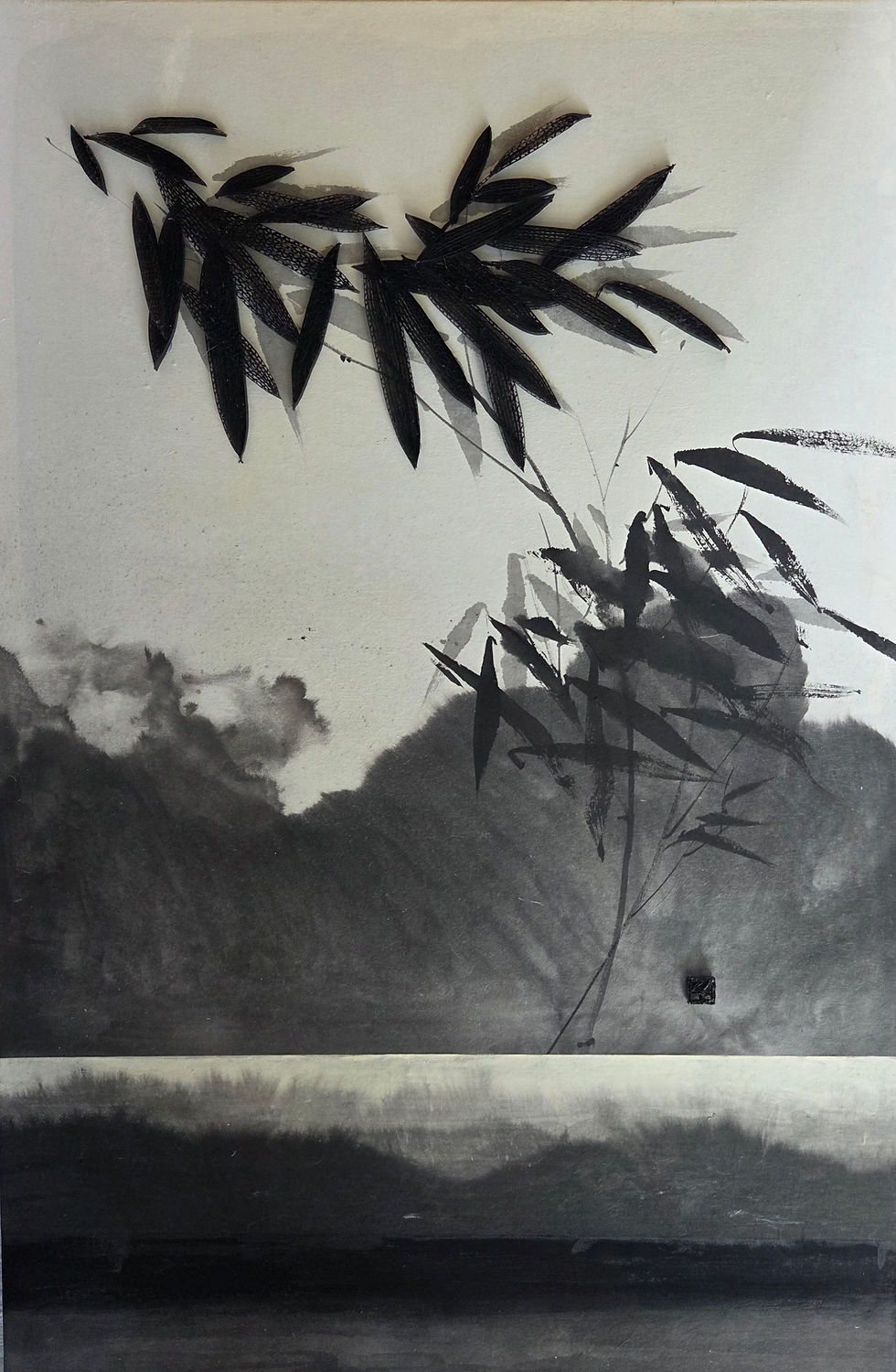
Sa gun ja, often translated as “The Four Gentlemen,” is an important subject in East Asian brush painting traditions, including Korean painting. These four plants are not chosen only for their beauty. They symbolize qualities of character, inner cultivation, and harmony with nature.
The plum blossom, which blooms in the cold, represents resilience, renewal, and the courage to flower before spring has fully arrived. The orchid suggests elegance, humility, and inner refinement. The chrysanthemum, blooming in autumn, is associated with quiet dignity, endurance, and contemplation. The bamboo represents integrity, flexibility, uprightness, and strength.
Among these four, bamboo holds a special place in this program because of its connection to Yun Seondo’s Ouga and YoungHwa Choi’s contemporary interpretation. In both poetry and painting, bamboo is admired for its strength and emptiness. Its hollow center suggests humility and openness. Its upright form suggests moral clarity. Its leaves move with the wind, but its roots remain firm.
During the workshop, participants will be invited to experience Korean painting through direct practice. They will learn how a brushstroke can carry rhythm, how ink can shift from dark to light, and how a simple natural form can express emotion and character. The workshop is designed not only as an art activity, but as a way to understand Korean aesthetics through the body and hand.
To paint bamboo is to practice balance.
To leave space is to practice restraint.
To follow the brush is to listen.
Live Performance: Korean Rhapsody: Sijo — A Love Letter
Within the larger Korean Rhapsody: Sijo program, Gallery B612 presents the live interdisciplinary performance Korean Rhapsody: Sijo — A Love Letter.
The subtitle A Love Letter belongs specifically to this live performance. It reflects the emotional center of Hwang Jini’s poem, but it also expands beyond romantic love. It becomes a love letter to Korean poetry, to cultural memory, to the Korean language, and to the living relationship between past and present. It is a love letter written not with a pen, but with body, brush, fabric, image, rhythm, and space.
The performance is inspired by Hwang Jini’s “Cheongsan-ri Byeokgyesu-ya” and reimagines the emotional world of Sijo through movement and live painting. Featuring movement by MiYoung Seul Margolis and live painting by Kyungmug Park, the work transforms Korean poetry into a visual and physical experience.
Through the long silk fan, Korean mask imagery, live brushwork, and contemporary movement, the performance invites audiences to feel Sijo rather than only read it. The poem’s verbal elegance becomes a visual and kinesthetic language. The wit of the poem becomes timing. The longing becomes gesture. The pause becomes stillness. The moonlight becomes atmosphere.
This performance will be presented twice during the program:
July 24 — Gallery B612
July 28 — Art Love Salon
MiYoung Seul Margolis: The Director’s Vision Behind Korean Rhapsody: Sijo
MiYoung Seul Margolis 설미영 is a Seattle-based Korean-American visual artist, choreographer, dancer, curator, cultural producer, and owner/director of Gallery B612. She is also the founder and executive director of O-Jak Bridge Art & Dance Festival, a platform dedicated to connecting visual art, dance, cultural memory, and community through interdisciplinary performance.
Her artistic practice often bridges Korean cultural memory, contemporary movement, visual art, and community-centered storytelling. Across her work, she explores themes of nature, womanhood, ritual, migration, spiritual inheritance, and the emotional landscapes carried by the body.

For Korean Rhapsody: Sijo, Margolis brings together her roles as artist, director, curator, performer, and cultural producer. The program reflects her ongoing interest in how Korean tradition can be translated into contemporary space without losing its emotional depth. Rather than presenting Sijo only as a historical literary form, she expands it into an interdisciplinary experience: a poem becomes an exhibition, a painting becomes a performance partner, a workshop becomes a way of touching tradition directly.
In Korean Rhapsody: Sijo — A Love Letter, her movement becomes a living line of poetry. Rather than acting out the poem literally, her body carries its rhythm, restraint, and emotional turning point. The performance draws from the subtle structure of Sijo: opening, expansion, and transformation. A gesture may begin as stillness, unfold into longing, and return to quiet strength.
Through her artistic direction, the program does not treat tradition as fixed. Instead, tradition becomes a source of movement, reinterpretation, and contemporary presence.
Gallery B612 and Korean Cultural Week
Gallery B612 is a Seattle-based contemporary art gallery dedicated to supporting artists, building cultural bridges, and creating meaningful encounters between visual art, performance, and community. Through exhibitions, artist programs, interdisciplinary events, and collaborations, the gallery serves as a space where local, national, and international voices can meet.
Presented during Seattle Art Fair week, Korean Rhapsody: Sijo positions Korean culture within a contemporary international art context. With the support of the Consulate General of the Republic of Korea in Seattle through Korean Cultural Week, the program creates a meaningful platform for Korean poetry, painting, performance, and cultural education to meet new audiences.
For Gallery B612, this program is also part of a larger mission: to create bridges between artists, cultures, histories, and communities. Korean Rhapsody: Sijo is not a museum-style presentation of tradition from a distance. It is an invitation to enter the tradition through multiple senses: reading, watching, listening, moving, and painting.
Audiences will encounter Sijo on the wall, in the body, through the brush, and in their own hands. They will meet Hwang Jini’s blue stream and bright moon, Yun Seondo’s bamboo and moon, Kyungmug Park’s layered ink and Hanji, YoungHwa Choi’s shadowed bamboo textures, MiYoung Seul Margolis’s visual and movement-based poetic memory, the expressive force of live painting, and the meditative discipline of Sagunja.
Together, these elements form a layered cultural experience. The program honors Korean tradition while allowing it to take new shape in the present. It shows that Sijo is not only an old poetic form, and Korean painting is not only an inherited technique. They are living languages that can still speak to love, memory, nature, identity, and belonging.
Korean Rhapsody: Sijo is Gallery B612’s offering to Korean art and culture during Seattle Art Fair week. Through poetry, painting, performance, and community participation, the program invites Seattle audiences to pause, look closely, and listen to the quiet power of Korean artistic tradition.


For anyone juggling multiple content platforms, the main challenge is keeping a single reference point that never feels outdated. A tool that allows unlimited links means you can add a new profile or project without deleting older ones, which is a practical advantage. The page itself is straightforward to set up, and the absence of a paywall for core features is refreshing in this niche. Creators who want to test whether a link hub improves their engagement can do so without upfront commitment. You can explore the full functionality on biovelt.com and decide if it solves your link management needs.
A friend shared a link to this scratch planet clicker-style game while we were talking about old Scratch projects, and I ended up trying the browser version instead. The interface is fairly clean, everything is separated well enough that nothing feels confusing. Tested it on an older laptop and it still ran fine, no crashes or noticeable slowdown.